
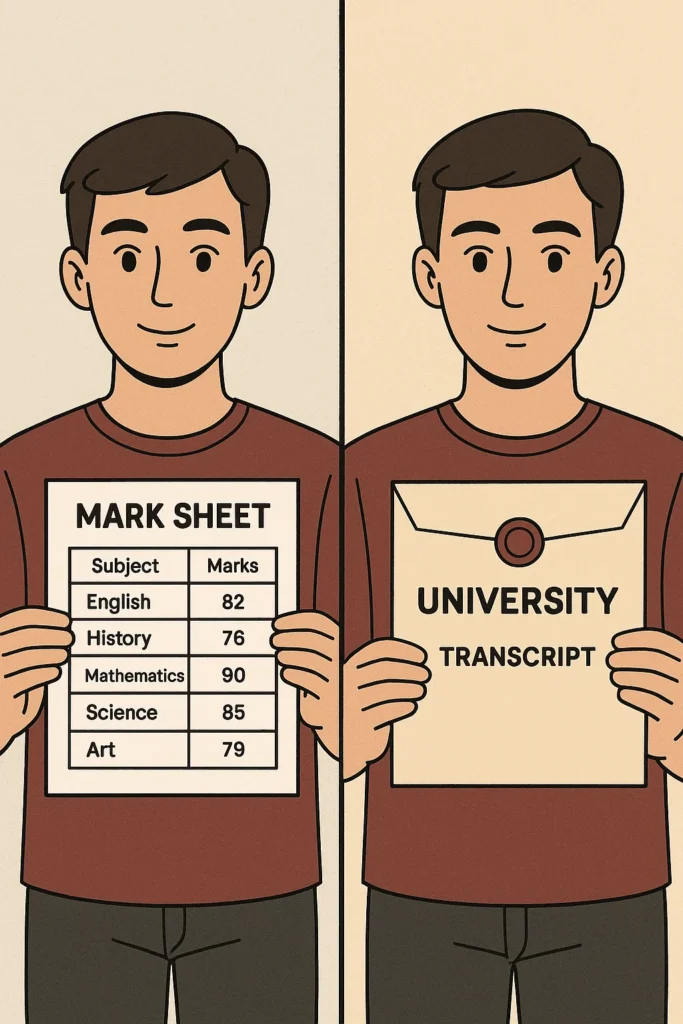
When navigating academic documentation, it’s easy to get confused between different records such as mark sheets and transcripts. Though they both reflect academic performance, they serve different purposes and are structured distinctly. This guide delves into their definitions, contents, functions, and practical implications.
What Is a Mark Sheet?
A mark sheet, often referred to as a marks memo or report card, is issued at the end of each academic term—be it a semester, trimester, or year. It provides a snapshot of performance, listing individual subjects along with the corresponding marks or grades for that session.
- Scope and Purpose: Designed to reflect your performance in a specific period.
- Frequency: You receive one for each academic term—multiple over the course of a degree.
- Contents: Features individual subject names and your marks or grades for each.
This document is typically sufficient for internal use, progress tracking, or as informal proof of academic history.
What Is an Academic Transcript?
In contrast, an academic transcript offers a more comprehensive and official account of your academic journey.
- Definition: A transcript aggregates your entire academic history—covering all semesters, courses, grades, credits, study period, and often cumulative GPA or marks.
- Other Names: It may be called a Statement of Learning, Transcript of Records (ToR), Consolidated Mark Sheet, Permanent Record, or Cumulative Record File, depending on the educational system.
- Details Included:
- Course names and codes
- Grades or marks obtained
- Credit hours or credit system
- Semester-wise and cumulative GPA
- Program specifics (degree, major, duration)
- Official authentication (institution seal, registrar signature)
- Role: A transcript is a formal, authenticated record, often required for admissions, employment, professional licensing, immigration, and scholarship applications.
Key Differences at a Glance
| Attribute | Mark Sheet | Transcript |
| Coverage | Single term or session | Entire academic program |
| Issued When | After each semester/year | Once after program completion (or consolidated) |
| Frequency | Multiple | Single, or consolidated at program end |
| Contents | Subject-wise marks/grades for one term | Full course load, grades, credits, GPA, and program details |
| Uses | Internal tracking, term-level reference | Admissions, employment, licensing, recognized formal document |
| Authentication | Basic (may vary by institution) | Official with institutional seal and signature |
Why Transcripts Matter More in Advanced Contexts
Transcripts carry significant weight for several reasons:
- Broader Academic Insight: They reflect your overall academic progress, trends across semesters, and total credits earned.
- Universal Acceptance: Higher education institutions, employers, immigration bodies, and licensing authorities often mandate transcripts, not term-wise mark sheets.
- Credential Evaluation: Foreign credential evaluation services rely on transcripts to assess equivalencies and chart recognition across education systems.
Clarifying Common Confusions
- In some systems, mark sheets may simply be called transcripts or vice versa, adding to the confusion. For example, Indian institutions often issue term-level mark sheets while the finalized, comprehensive document is termed a transcript.
- On forums, individuals have noted confusion but also recognized that terms are sometimes used interchangeably, though their practical implications differ.
Practical Scenarios: When You Need Which
Applying for Higher Education or International Programs
Submit an official transcript that consolidates all semesters, including grades, credits, cumulative GPA, and authenticated seals. Mark sheets alone might be insufficient.
Immigration or Professional Licensing
Transcripts are preferred, as they provide a verified and complete academic history. Mark sheets can supplement but rarely replace transcripts in such cases.
Internal Academic Use
Your university may accept individual mark sheets for course registration, internal verifications, or internal transfers.
Tips for Handling These Documents
- Request Early: Transcript processing can take time—plan ahead for admissions or official submissions.
- Ensure Authenticity: Always request official transcripts bearing institutional seals and official signatures. Self-generated or unofficial copies may not be accepted in formal settings.
- Consistent Data: Make sure personal details and program information match across all documents to prevent evaluation issues.
- Check Institution Policies: Some institutions may issue consolidated mark sheets instead of full transcripts; understand what’s acceptable for your intended use.
- Get Provisional Versions if Needed: If graduation is pending, request a provisional transcript to support applications, with the full transcript to follow later.
Final Thoughts
While mark sheets and transcripts both fulfill educational record-keeping roles, they differ in structure, scope, and official recognition. A mark sheet reflects individual term performance, whereas a transcript encapsulates your entire academic career in an authenticated format.
Choosing the right document is essential depending on your goals—whether securing admission, migrating, seeking jobs, or applying for scholarships. When in doubt, always opt for the fuller, officially issued transcript to ensure credibility and compliance.