
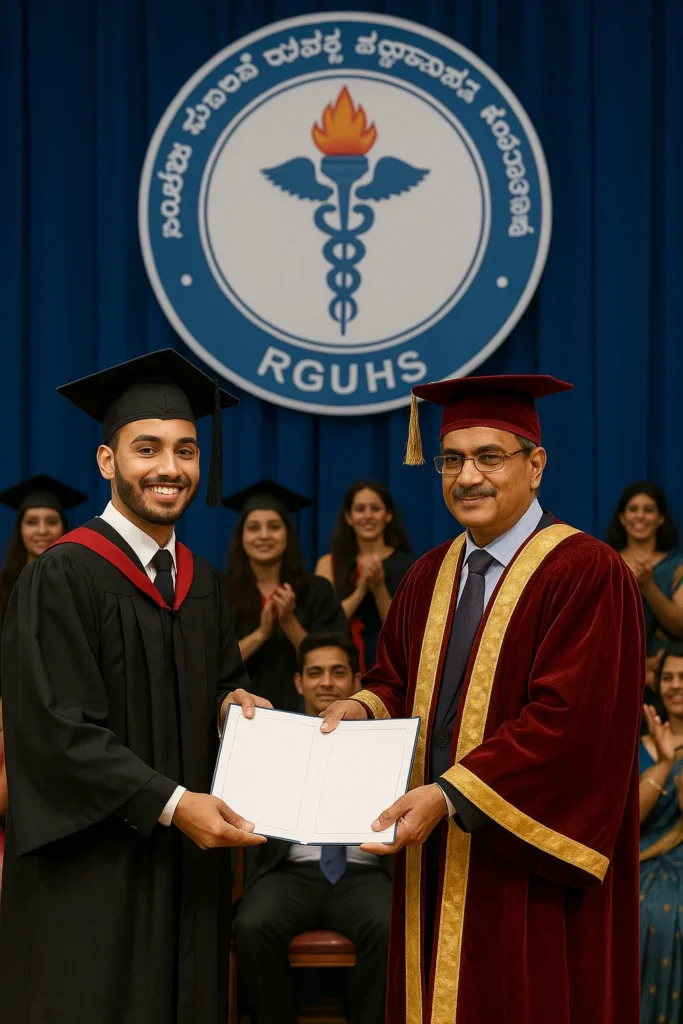
Rajiv Gandhi University of Health Sciences (RGUHS) in Karnataka is one of the most prominent institutions in India for health sciences education. With thousands of students graduating every year in fields like medicine, dentistry, nursing, pharmacy, physiotherapy, and allied health sciences, the university plays a vital role in shaping the healthcare workforce both in India and abroad.
For every student completing their course, one of the most important academic documents is the Convocation Certificate. This document is not merely a piece of paper—it is the official and final proof that a student has successfully earned a degree from the university. Whether it’s for pursuing higher studies, applying for jobs, immigrating to another country, or seeking professional licensure, the convocation certificate is indispensable.
This blog provides a comprehensive guide on the RGUHS Convocation Certificate, explaining its importance, application process, common challenges, and why students often rely on it for their career progression.
What is an RGUHS Convocation Certificate?
A convocation certificate is the official degree certificate awarded to a student after successful completion of a program at RGUHS. Unlike provisional certificates, which are issued temporarily until the convocation ceremony is held, the convocation certificate is the permanent record of the degree awarded.
The certificate typically contains:
- Student’s name as per university records.
- Name of the course and specialization.
- Year of completion.
- Official signature of the university authority.
- University seal to confirm authenticity.
Why is the Convocation Certificate Important?
The RGUHS convocation certificate holds immense value for students and graduates for several reasons:
1. Proof of Degree Completion
It acts as the ultimate proof that a student has graduated and earned the qualification.
2. Higher Studies Abroad
Foreign universities require the degree certificate along with transcripts during the admission process. Without it, applications may be considered incomplete.
3. Immigration and Credential Evaluation
Agencies such as WES, IQAS, ICAS, and ICES insist on official degree certificates when assessing international qualifications.
4. Professional Licensing
Bodies like CGFNS, ECFMG, NMC, and others require degree certificates as part of their licensing process for healthcare professionals.
5. Employment Opportunities
Employers, especially multinational organizations, often demand a convocation certificate to verify academic qualifications.
Provisional Certificate vs. Convocation Certificate
Many students often get confused between a provisional certificate and a convocation certificate.
- Provisional Certificate: Issued soon after completion of the program, before the formal convocation ceremony. It temporarily serves as proof of qualification until the final certificate is issued.
- Convocation Certificate: The permanent and final degree certificate awarded during or after the convocation. It is valid for a lifetime and is accepted globally.
While provisional certificates may serve in the interim, most institutions and agencies abroad will eventually insist on the convocation certificate.
Application Process for RGUHS Convocation Certificate
Obtaining the convocation certificate from RGUHS involves a structured process. Here’s how it usually works:
Step 1: Eligibility
Only students who have successfully cleared all examinations and fulfilled course requirements are eligible.
Step 2: Application Submission
- Students or graduates must fill out the convocation application form.
- Applications are usually invited before the annual convocation ceremony.
Step 3: Required Documents
The following documents are commonly required:
- Copy of provisional degree certificate.
- Copies of all mark sheets.
- Recent passport-size photographs.
- Identity proof such as Aadhaar card or passport.
Step 4: Fee Payment
The university charges a prescribed fee for the convocation certificate, which must be paid along with the application.
Step 5: Verification by University
The university cross-verifies the academic records before printing the certificate.
Step 6: Issue of Certificate
Certificates are issued during the convocation ceremony or dispatched by the university afterward if the student is unable to attend in person.
Common Challenges Faced by Students
- Delays in Processing
Convocation certificates may take time to be issued, especially if there is backlog in the university. - Geographical Barriers
Students residing outside Karnataka or abroad may find it difficult to attend convocation or apply directly. - Incomplete Information
Errors in application forms or missing documents can lead to delays or rejections. - Urgent International Requirements
Students applying abroad may need their degree certificate sooner than the convocation timeline, creating a gap between provisional and final certificate availability.
Convocation Certificate for International Use
When applying to universities, immigration boards, or professional councils abroad, the convocation certificate is mandatory. Most foreign bodies will not accept provisional certificates alone.
Examples include:
- Canada PR through Express Entry: Agencies like WES require degree certificates.
- UK Nursing Applications: NMC requires a final degree certificate as part of verification.
- US Licensing: CGFNS and ECFMG need convocation certificates to validate eligibility.
Importance of Professional Support
Many students, especially those settled abroad, face difficulty in applying for convocation certificates on their own. Professional academic service providers often help by:
- Filling and submitting applications on behalf of the student.
- Coordinating with the university to ensure proper processing.
- Handling courier and sealed envelope dispatch to international agencies.
- Providing updates throughout the process.
This not only saves time but also ensures documents are received in the correct format without errors.
Final Thoughts
The RGUHS Convocation Certificate is more than a ceremonial document—it is the ultimate proof of a graduate’s academic achievement. Whether one is applying for higher education, seeking global job opportunities, or working toward professional licensing, this certificate holds lifetime value.
Graduates should ensure they apply for and secure their convocation certificate without delay, as it will be required at multiple stages of their career journey. While provisional certificates may serve temporarily, the convocation certificate is the true validation of success at RGUHS.